Remaining Useful Life Appraisal: Write Off Your Property Faster
The remaining useful life estimated by the tax office for a property often has little to do with reality. Do you believe that your property has a significantly shorter economic residual useful life? Would you like to depreciate your building faster accordingly? A residual useful life appraisal, also known as a building fabric appraisal or useful life appraisal, can help you achieve these tax savings.
Published on 13 April 2026Updated on 28 September 2026
Known from
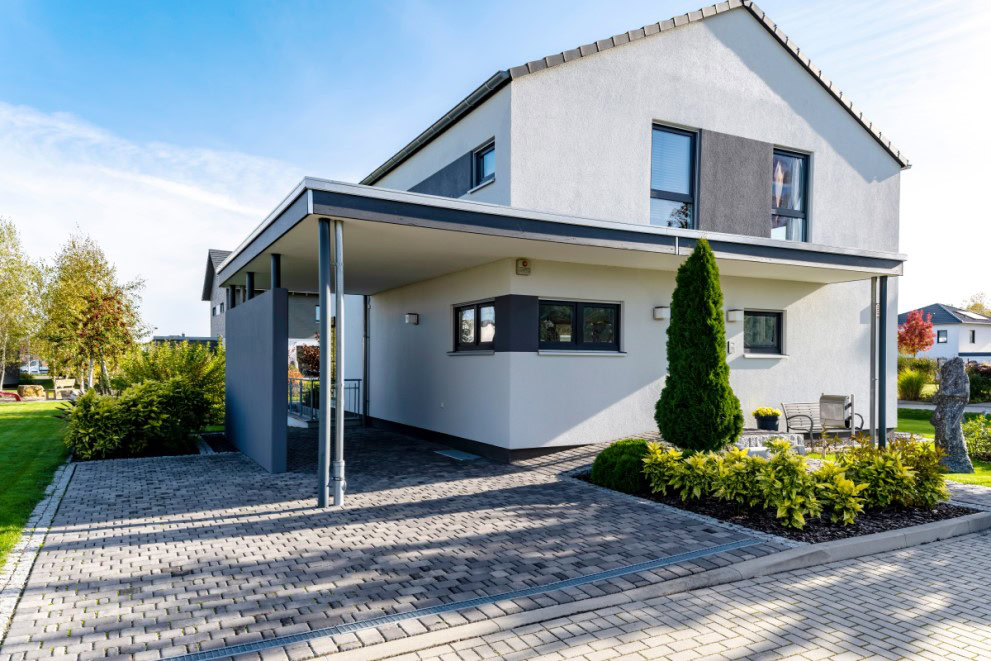
Two neighboring buildings: from the same year, in the same location, but due to their respective conditions with a very different remaining useful life.
The Most Important Facts at a Glance
With a suitable valuation report from Heid Real Estate Valuation, you can prove to the tax office that your property has a shorter useful life.
The main criteria for a shorter useful life and thus the possibility of a significantly reduced depreciation for wear and tear (Abschreibung für Abnutzung, AfA) are economic devaluation, legal restrictions on use, and technical wear and tear.
Proof is provided by an appraisal from a certified expert. Such expert opinions, which serve precisely this purpose, usually bear names such as building substance appraisal, useful life appraisal, or remaining useful life appraisal.
The reduction of the remaining useful life can never be done wholesale, but requires a case-by-case decision.
Your Advantages with Heid
Legally Compliant
Our remaining useful life appraisals are recognized by the tax office.
Inspection
We personally inspect your property and all its components.
Tech + Business
Our experts assess the technical and economic condition of the property.
Fixed Price
We will provide you with a fixed price offer for determining the remaining useful life of your building.
Follow-Up Support
Our appraisers are available to answer any questions you may have from the tax office.
Remaining useful life appraisals result from a requirement of the Income Tax Act. Section 7 (4) sentence 2 EStGstates: “If the actual useful life of a building is [less than x] years, the depreciation corresponding to the actual useful life may be applied instead of the depreciation according to sentence 1.”
Taxpayers can independently demonstrate a shortened remaining useful life to the tax office. The tax office reviews the taxpayer’s argument and justifies its rejection. However, if the taxpayer submits a residual useful life assessment by a publicly appointed and sworn expert, or at least one certified by institutes such as TÜV and DEKRA, who has inspected the property and can prove an appropriate reduction in useful life, it will be very difficult for the tax officer to disallow the lower remaining useful life.
Remaining Useful Life Appraisals Shorten the Economic Useful Life of Buildings on Paper
The useful life is defined in accordance with the Income Tax Implementation Regulation (§ 11c (1) sentence 1 EStDV) as the period during which a building is expected to serve its intended purpose. If a building is actually used for less than the period specified in the Real Estate Valuation Ordinance (Annex 1 ImmoWertV) or the Mortgage Lending Value Determination Ordinance (Annex 2 BelWertV), the depreciation for wear and tear (AfA) may, in exceptional cases, be calculated in accordance with the actual useful life in accordance with the Income Tax Act (§ 7 (4) sentence 2 EStG).
Real estate that is part of business assets and is not used for residential purposes must have a remaining economic useful life of less than 25 years if the building application was submitted between April 1, 1985, and December 31, 2000. For newer buildings owned by companies, the remaining useful life must be less than 33.33 years.
For properties that do not meet these criteria – which would be mainly privately owned residential buildings – the following standards apply:
If the house was completed before 1925, the remaining useful life must be less than 40 years in order to apply for a reduction in depreciation.
For houses built between 1925 and 2022, the remaining useful life must be less than 50 years.
For properties completed after 2023, it is only worth attempting to reduce depreciation if the remaining useful life is less than 33.33 years.
Those who know the actual condition and remaining useful life of their property can optimize depreciation in a targeted manner with the help of a remaining useful life appraisal.
Dipl. Ing. André Heid M.Sc.
Criteria for Shortening the Remaining Useful Life
Technical wear and tear, economic depreciation, and legal restrictions on use can shorten the remaining useful life of a property. If these factors apply, an appraisal can be used to shorten the remaining useful life.
Let’s take the constantly changing fire safety regulations as a concrete example. Fire safety requires costly renovations in publicly accessible buildings – i.e., pretty much every retail store. The remaining useful life of a DIY store is reduced to an estimated ten years due to energy and fire safety regulations while, in fact, a total useful life of 30 years is intended for such a specialty store.
Things become particularly interesting when the building is used for different purposes, for example, partly as office space and partly by retailers.
Whether and, if so, by how much the remaining useful life can be shortened with the help of an expert appraisal is always decided on a case-by-case basis. Although the structure is rarely a reason for reducing the remaining useful life, a corresponding useful life assessment is generally also offered as a building structure assessment.
Building Structure Assessments Ensure Faster Depreciation
A shortened remaining useful life applies not only to buildings, but also to parts of them that are to be regarded as independent immovableeconomic goods and building parts. This therefore applies to fixtures and fittings in shops, leisure facilities (prime example: discotheques or escape rooms – where rooms are commonly completely redesigned every few years) and restaurants (see Income Tax Guideline R 4.2 (3) sentence 3 EStR). However, the option of reducing depreciation is only available if the fixtures and fittings are integral or not used as operating equipment. If the fixtures and fittings are essential for the structural integrity of the building, the depreciation period cannot be reduced either.
Installations and alterations by tenants may also result in a reduction in depreciation if this leads to an actual reduction in the useful life due to a potentially shortened lease term. This is stated in the aforementioned letter from the Federal Ministry of Finance, point 3.1.
In the case of tenant installations and conversions, such as in a restaurant kitchen, the actual useful life may be shorter than the standard depreciation rates applicable to the building.
Conditions of Verification in Useful Life Appraisals
The expert who prepared the remaining useful life appraisal must be publicly appointed and sworn in – specifically for the valuation of developed and undeveloped properties. Alternatively, officials should also recognize certification from a body accredited according to DIN EN ISO/IEC 17024 as an expert or appraiser for the valuation of real estate according to the relevant standard. The appraisers at Heid Real Estate Valuation are fully qualified and certified. We can help you to significantly reduce the depreciation of your rented, non-modernized property.
Please note: Many tax offices only accept remaining useful life appraisals if the expert has actually inspected the property to be appraised. Although there are currently no uniform guidelines or processes for how such an appraisal must be prepared, when commissioning a remaining useful life appraiser, make sure that they personally inspect the property or real estate.
In addition, a description of the building structure is mandatory. For this reason, the residual useful life appraisal is often referred to as a building structure assessment or appraisal.
In order to avoid disputes with the tax office, the expert should use legally compliant valuation methods.
Count on Heid for Your Useful Life Appraisals
Our reports are convincing – even to courts and tax authorities. A very high acceptance rate confirms our high quality and professional competence.
Free follow-up support: If tax officials have doubts about the shortened useful life, we will be happy to clear them up. At no extra charge.
With around 220 experts throughout Germany, we also have a competent expert on site in your region.
Our remaining useful life experts are publicly appointed and sworn. Naturally, they are certified according to DIN EN ISO/IEC 17024.
The authorities value thoroughness. For Heid experts, an on-site inspection of the property is therefore mandatory.
Fast processing: Once all documents are available, you will usually receive your appraisal within 10 business days.
The useful life appraisal itself is tax deductible. We are happy to prepare a free cover letter for the tax office.
Example of a Recreational Property: Higher Depreciation Thanks tot the Remaining Useful Life Appraisal
Let’s assume you are the owner of a recreational property where escape rooms await players who voluntarily lock themselves in for an hour to escape by guessing puzzles and interacting with the inventory. Let’s assume that you have this operating property in your private portfolio and have to pay tax on it at your personal income tax rate. (Note: This does not make sense for an investment property.)
You purchased the property for € 300,000. In this specific case, the land value is two-fifths, while the building accounts for three-fifths of the market value. The building value share is the basis for depreciation for wear and tear, as the escape room does not diminish the value of the land.
The tax office assumes a total economic useful life of 30 years. You can depreciate just under € 6,000 per year. Since you have made high profits elsewhere and may not want to hold on to this property for long, you are aiming for higher, faster depreciation. You commission a remaining useful life appraisal for €1,500 (gross).
The appraiser has no problem shortening the economic remaining useful life to 10 years due to the need for regular complete renovation of the rooms in accordance with safety-related aspects. Suddenly, you can claim € 18,000 per year. This means that, on paper, you earn around € 12,000 less per year. This results in a tax saving of roughly € 5,000 per year over the decade. After that, the building is completely depreciated and no longer has any tax benefits for you as the owner.
Cost
old
new
Acquisition costs
€ 300,000
€ 300,000
Land value
€ 120,000
€ 120,000
Building (market) value
€ 180,000
€ 180,000
Remaining useful life
30 years
10 years
Depreciation for wear and tear (p.a.)
3.33 %
10 %
Depreciation for wear and tear per year
€ 5,994
€ 18,000
Income tax rate
42 %
42 %
Reduction in income
/
€ 12,006
Tax savings per year
/
€ 5,043
Table with sample calculation showing the tax savings a remaining useful life appraisal can earn for an escape room.
Remaining Useful Life Appraisal: Download a Sample
To help you understand the procedure, we have provided a sample remaining useful life appraisal here. It serves as a guide and shows which points are covered. This sample appraisal contains all the essential factors, such as the inventory of the building, the evaluation of the building structure, and the argument for a shortened remaining useful life. The sample gives you a realistic idea of how an appraisal is structured in order to realistically present the remaining useful life of a property to the tax office.
When a Remaining Useful Life Appraisal Has an Advantage Over a Market Value Appraisal
A market value appraisal costs from € 2,890 and provides comprehensive proof of the value of the property. As soon as the value of the property becomes relevant for accounting, tax, or legal purposes, a market value appraisal is the right choice. The remaining useful life is determined in this context using the dot grid method. This is not sufficient as proof of a reduction in the remaining useful life.
A remaining useful life appraisal is less expensive. It is useful if the sole purpose is to shorten the useful life for tax purposes and the property is heavily worn. For a modernized property, a useful life appraisal to reduce depreciation is not advisable, as this increases the remaining useful life.
Useful Life Appraisal
Comparison
Market Value Appraisal
from € 1,690
Cost
from € 2,890
20 to 30
Pages
60 to 120
Faster depreciation
Purpose
Multi-purpose value determination
rented
Building
all
worn, not modernized
State of repair
all
Comparison of remaining useful life appraisals and versatile market value appraisals.
As a result of the letter issued by the Federal Ministry of Finance on December 1, 2025, the requirements for proving the remaining useful life are no longer as strict as they previously were. Nevertheless, a remaining useful life appraisal is recommended, as this document, issued by a DIN 17024-certified expert, constitutes a meticulous and appropriate form of evidence.
Your advantage with Heid: Regardless of which appraisal you commission from the experts at Heid Real Estate Valuation, you will benefit from free follow-up support.
Wir haben uns ein Kurzgutachten für den privaten Gebrauch erstellen lassen und fanden das ganz toll.
Aaron Müller
4 months ago
Mit Heid Immobilienbewertung haben wir Experten in Ihrem Fachbereich an unserer Seite. Sind sehr froh hierhergekommen zu sein und können wir nur wärmstens weiterempfehlen.
Sabrina Shuster
6 days ago
Gutachtenerstellung ging äußerst flott und bestens. Unsere Erfahrung mit Heid war stets positiv und können wir daher nur empfehlen.
Mathias Kaiser
3 weeks ago
These Rulings Legitimize Expert Opinions on Remaining Useful Life
The following rulings legitimize expert opinions on remaining useful life from publicly appointed and sworn experts. The tax office must therefore recognize them.
Federal Finance Court
As the highest authority, the Federal Finance Court issued a ruling (file number IX R 25/19) on July 28, 2021, which legitimizes useful life appraisals as evidence for faster depreciation. In its ruling IX R 14/23 of January 23, 2023, the Court significantly relaxes the strict rules of the Federal Ministry of Finance on shortened depreciation periods.
A recent ruling by the Federal Finance Court of January 21, 2024 – IX R 14/23 partially contradicts the requirements of the Ministry of Finance. The guiding principle of the ruling is that the taxpayer may use any expert method that appears suitable as evidence of a shorter actual useful life. A reference to the model-based total and remaining useful life of a building in accordance with the ImmoWertV (German Real Estate Valuation Ordinance) is not sufficient for this purpose.
Summing up the above court rulings: Not only the technical, but also the economic residual useful life must be recognized by the tax office. The taxpayer may use “any method of presentation” that “appears appropriate in the individual case” to shorten the useful life.
Cologne Fiscal Court
In its ruling of July 9, 2022 (Ref. 6 K 923/20), the Cologne Fiscal Court confirmed: A model-based residual useful life (technical wear and tear, economic residual useful life, legal restrictions on use, etc.) is sufficient as a basis for the depreciation rate. A building structure assessment focusing on the building structure itself is therefore not necessary.
Münster Fiscal Court
The economic remaining useful life of commercial real estate can be used as the basis for the depreciation rate if it has been plausibly demonstrated in a corresponding valuation report. This was announced by the Münster Fiscal Court on January 27, 2022 (Ref. 1 K 1741/18 E) and confirmed once again in its judgments 1 K 3840/19 and 1 K 3841/19 F.
The building structure is the main factor determining the remaining economic useful life.
Frequently Asked Questions about Remaining Useful Life Appraisals
In this section, we answer frequently asked questions about remaining useful life appraisals.
What Is the Scope of a Remaining Useful Life Appraisal?
A useful life appraisal comprises approximately 20 to 30 pages, depending on the building. New buildings generally require fewer pages than older buildings.
What Kinds of Data and Documents are Relevant for a Remaining Useful Life Appraisal?
In principle, an expert requires the same documents for a useful life appraisal as for a market value appraisal. The most important document is the building specifications and a list of significant damage, maintenance, and modernization measures carried out over the past 20 years.
You should also provide your appraiser with copies of the following documents:
Current land registry extract
Building permit
Construction drawings, floor plans of all floors, sections, and elevations
Area and room calculations (living space, cubic volume calculation, usable space, and gross floor area)
Official site plan
Energy performance certificate
Our appraiser will personally inspect the property and identify features and conditions that shorten the remaining useful life of the building.
Technical vs. Economic Total and Remaining Useful Life: What Are the Differences?
The technical useful life of real estate often differs from how long it can be used economically. In the Real Estate Valuation Ordinance and the Mortgage Lending Value Ordinance, the legislator has defined the total useful life of different types of buildings in a model manner. The remaining useful life is derived from this, but can be extended through modernization and shortened by increased wear and tear, for example.
Air conditioning systems in an industrial property can influence the technical useful life.
How Much Does a Remaining Useful Life Appraisal Shorten the Depreciation Period?
The extent to which the remaining useful life can be shortened on paper, i.e., in the tax return, depends on the specific property. To this end, the expert considers technical wear and tear, economic use, and legal restrictions. In the case of non-modernized residential properties, highly complex special properties with rapid wear and tear, and heavily used commercial properties, a remaining useful life appraisal often allows for significantly faster depreciation.
When Is a Remaining Useful Life Appraisal Worthwhile?
You need a useful life appraisal if you want to shorten the depreciation period for your property. A remaining useful life appraisal can be worthwhile if the economic remaining useful life is significantly shorter than the useful life of the property as specified in the ImmoWertV (German Real Estate Valuation Ordinance).
The advantage of the shortened remaining useful life applies not only to the building, but also to fixtures and fittings. If you own a property that needs to be fundamentally renovated at relatively short intervals in order to fulfill its purpose, the useful life assessment is definitely worthwhile.
Can I Combine a Remaining Useful Life Appraisal with an Energy Consultation?
The combination can help to assess whether energy investments are worthwhile if the remaining useful life of the building is still sufficiently long, or whether an early replacement for the current building with better energy efficiency makes more economic sense.
Which Remaining Useful Life Appraisals Are Recognized by the Tax Office?
A remaining useful life appraisal verifies the actual remaining useful life of the building using two calculation variants. It thus goes far beyond the dot grid method. A basic prerequisite for the recognition of the appraisal is that the expert has the necessary qualifications (ideally: publicly appointed and sworn as well as further training as a construction expert) and inspects the property on site. With the experts at Heid Real Estate Valuation, you are therefore in good hands.
Reduce Tax Payments with Appraisals on Remaining Useful Life
The experts at Heid Real Estate Valuation prepare remaining useful life appraisals for all types of buildings, from multi-family houses and classic commercial properties to special properties. We use two variants to explain why the remaining useful life can be shortened and by how much. The level of detail goes far beyond the dot grid method. Wear and tear is broken down to the individual components.
With a remaining useful life appraisal from Heid Real Estate Valuation, you benefit from the dual control principle, a property inspection, and the useful life appraisals of several other expert offices. reports and useful life reports from some other expert agencies, you benefit from the two-man rule, a property inspection, and free follow-up support in case of queries.
After a free initial consultation, we’ll work with you to agree on a fixed price for your property valuation. You will receive a professional appraisal report that, if needed, is fully valid in court and with government authorities.
We also accept short-notice assignments at our many expert offices across Germany. We look forward to your inquiry!
Heid Real Estate Valuation
Memberships:
Deutscher Gutachter & Sachverständigenverband (DGuSV – The German Association of Professional Experts)
VDI, Verein deutscher Ingenieure (The Association of German Engineers)